
Heavy metal pollution in soil is a major threat to food safety and ecosystems. In response, Academician Duan Xue’s team introduced the groundbreaking “Ultra-stable Mineralization” theory. Having mastered the large-scale synthesis of LDHs (Layered Double Hydroxides), the team has successfully implemented remediation strategies in multiple Chinese provinces, demonstrating the practical superiority of LDH-based mineralizers. Despite these advances, Cd–As co-contamination presents a unique hurdle due to the pollutants’ opposing geochemical behaviors. Specifically, the competitive advantage of Cd2+ in binding to active sites suppresses the effective sequestration of AsIII, necessitating the development of novel materials capable of synergistic mineralization.
Associate Professors Wenying Shi and Xianggui Kong, from the team of Academician Duan Xue, recently published a study in Nature Communications, revealing the fundamental scientific essence of “Ultra-stable Mineralization”. Using MgMn-LDO (Layered Double Oxides) derived from topotactic transformation, they achieved spatiotemporal decoupling of AsIII oxidation and Cd2+ adsorption. This approach effectively eliminates competitive inhibition, resulting in ultra-high adsorption capacities and a 181–fold acceleration in As mineralization. The study establishes a new mechanism of “adsorption-oxidation decoupling” for the synergistic remediation of complex pollutants.
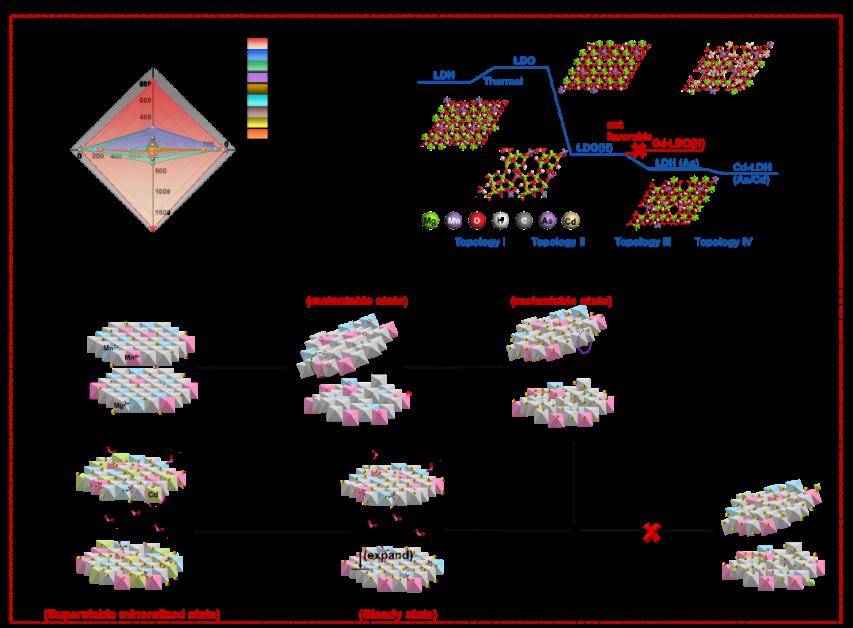
Figure 1. Comparison of adsorption capacities, schematic of the four-stage topotactic transformation, and Gibbs free energy diagrams of LDO.