
On the morning of April 29, 2026, Professor Zhang Hua from City University of Hong Kong was invited to visit the College of Chemistry, Beijing University of Chemical Technology, and delivered an academic lecture entitledPhase Engineering of Nanomaterials (PEN) in the lecture hall on the second floor of the Library
Conference Center. Faculty and students engaged in relevant research fields attended the seminar.
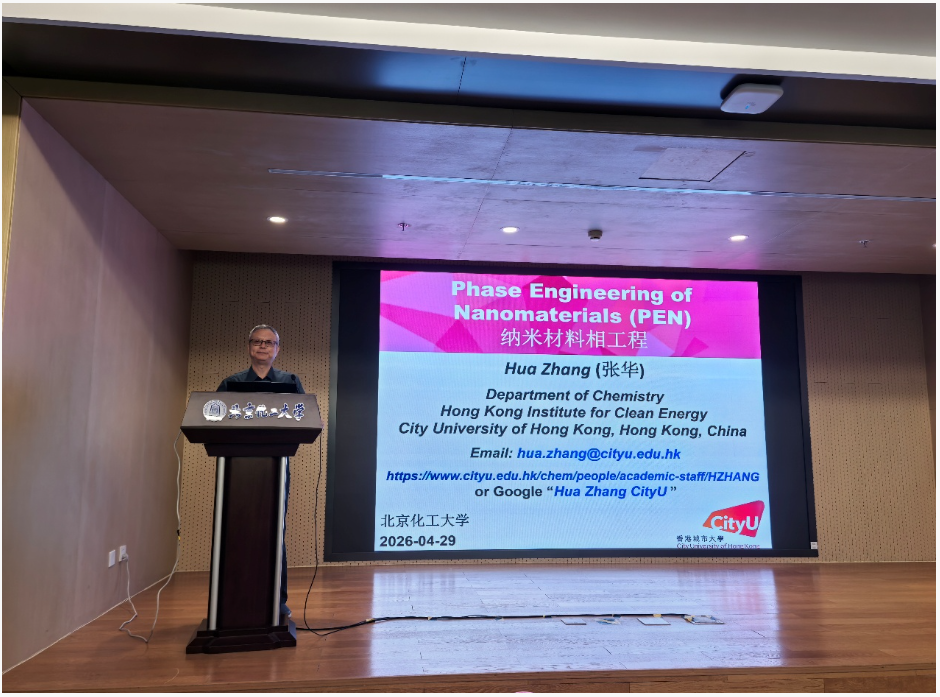
In his presentation, centered on Phase Engineering of Nanomaterials (PEN), a cutting-edge research frontier, Professor Zhang systematically presented the latest advances achieved by his research group in the rational design, controllable synthesis and functional diversification of nanomaterials with unconventional crystal phases. He pointed out that crystal phase structure acts as a decisive factor governing the electronic configuration, surface and interfacial properties, as well as catalytic performance of nanomaterials. Structural modulation via phase engineering offers an innovative research route for developing high-performance functional nanomaterials.
Professor Zhang elaborated on the rational design and synthetic methodologies of metallic nanomaterials bearing unconventional phases. Specifically, his group synthesized unconventional-phase Au nanostructures and 2H-phase Pd nanoparticles via wet-chemical routes. On this basis, epitaxial growth of diverse metallic nanostructures was implemented to fabricate functional materials featuring distinctive phase configurations and heterogeneous interfaces. Moreover, he illustrated the synthetic protocols and structural characteristics of amorphous/crystalline heterogeneous Pd, PdCuRh and Rh alloy nanosheets, demonstrating the pivotal role of phase modulation in boosting material performance.
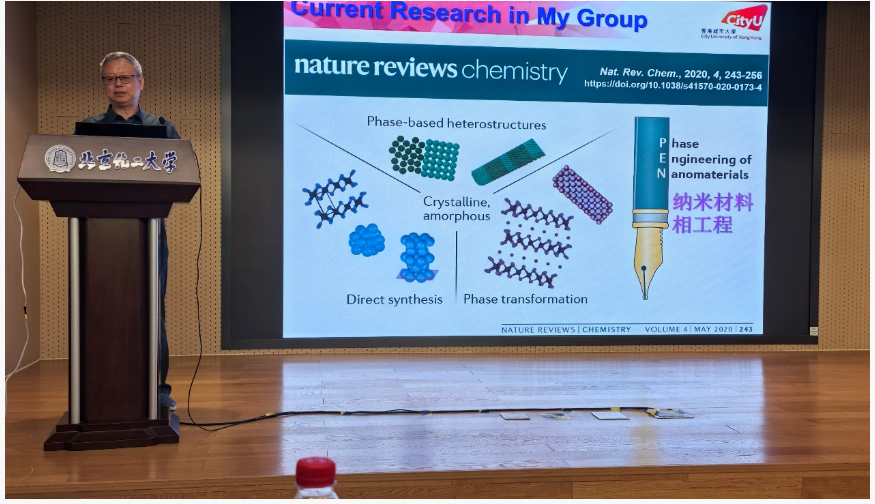
Subsequently, Professor Zhang introduced his group’s progress on phase engineering of transition metal dichalcogenides (TMDs). Metastable group-VI transition metal dichalcogenides with 1T phase were fabricated through gas-solid reactions. A salt-assisted strategy was adopted to realize and visualize the phase transition from the 2H phase to the 1T phase. Additionally, he shared a lithiation-induced amorphization strategy for synthesizing Pd₃P₂S₈, further demonstrating the great potential of phase engineering in expanding the structural library and functional scope of nanomaterials.
During the Q&A session, participating faculty and students held in-depth discussions with Professor Zhang covering multiple topics: the controllable fabrication of unconventional-phase nanomaterials, stabilization mechanisms of metastable crystal phases, precise construction of heterogeneous interfaces, impacts of phase regulation on catalytic activity and selectivity, as well as application prospects of phase engineering strategies in energy conversion, electrocatalysis and functional material design. Drawing on his group’s research findings, Professor Zhang provided detailed answers to all raised questions and shared his insights regarding structural design, mechanistic investigation and functional extension of nanomaterials.
This comprehensive and in-depth presentation covered core research areas including phase engineering of nanomaterials, crystalline heterostructures and heterogeneous nanomaterials, highlighting the vital value of phase structure modulation for the design of functional nanomaterials. This academic exchange broadened the understanding of faculty and students at Beijing University of Chemical Technology on state-of-the-art progress in phase engineering of nanomaterials, and delivered valuable inspirations for research in related disciplines such as materials chemistry, nanoscience, catalysis and energy conversion.
Speaker Biography
Professor Zhang Hua is currently a Professor at City University of Hong Kong. He was elected Foreign Member of the European Academy of Sciences in 2020, Fellow of the Asia Pacific Academy of Materials in 2015, and Fellow of the Royal Society of Chemistry in 2014. His long-standing research focuses on phase engineering of nanomaterials, two-dimensional materials, heterogeneous nanomaterials and functional nanomaterials. He commands prominent academic influence in the global fields of materials chemistry and nanoscience.
Professor Zhang has been included in the list of Highly Cited Researchers and the World’s Most Influential Scientific Minds. He was named one of the World’s Hottest Researchers in both 2014 and 2015, and ranked first in the Materials and More category in 2014. To date, he has contributed book chapters to eight monographs, filed more than 100 patents, and published over 600 peer-reviewed research articles. His work has accumulated more than 169,000 citations on Google Scholar with an h-index of 202.
Professor Zhang has received numerous prestigious awards, including the Croucher Foundation Senior Researcher Award, Bank of Hong Kong Science and Technology Innovation Award, CityU Outstanding Research Award, CityU President’s Award, University of Wollongong Vice-Chancellor’s International Scholar Award, and ACS Nano Lectureship Award from the American Chemical Society. He currently serves as Co-Editor-in-Chief ofSmartMat and Chair of the Editorial Board forChemNanoMat. Additionally, he acts as an editorial board member or advisory board member for over 30 international journals, such asACS Nano,Advanced Functional Materials, andAdvanced Materials.