
Elucidating the mechanism of reactive oxygen species and their specific role in enhancing product selectivity remains a critical challenge. On January 06,Shao’s team has proposed a strategy to clarify the contribution of reactive oxygen species to the C–C bond cleavage of vicinal diols during alcohol electrooxidation, demonstrating that lattice oxygen can significantly promote this bond cleavage and improve product selectivity. This approach overcomes the challenge in conventional catalysts that cannot simultaneously achieve efficient C(OH)–C(OH) bond fracture and high-purity product generation. The study, entitled “Lattice Oxygen Mediated C(OH)−C(OH) Bond Cleavage to Promote Alcohols Electrooxidation,” has been published in Angew. Chem. Int. Ed.
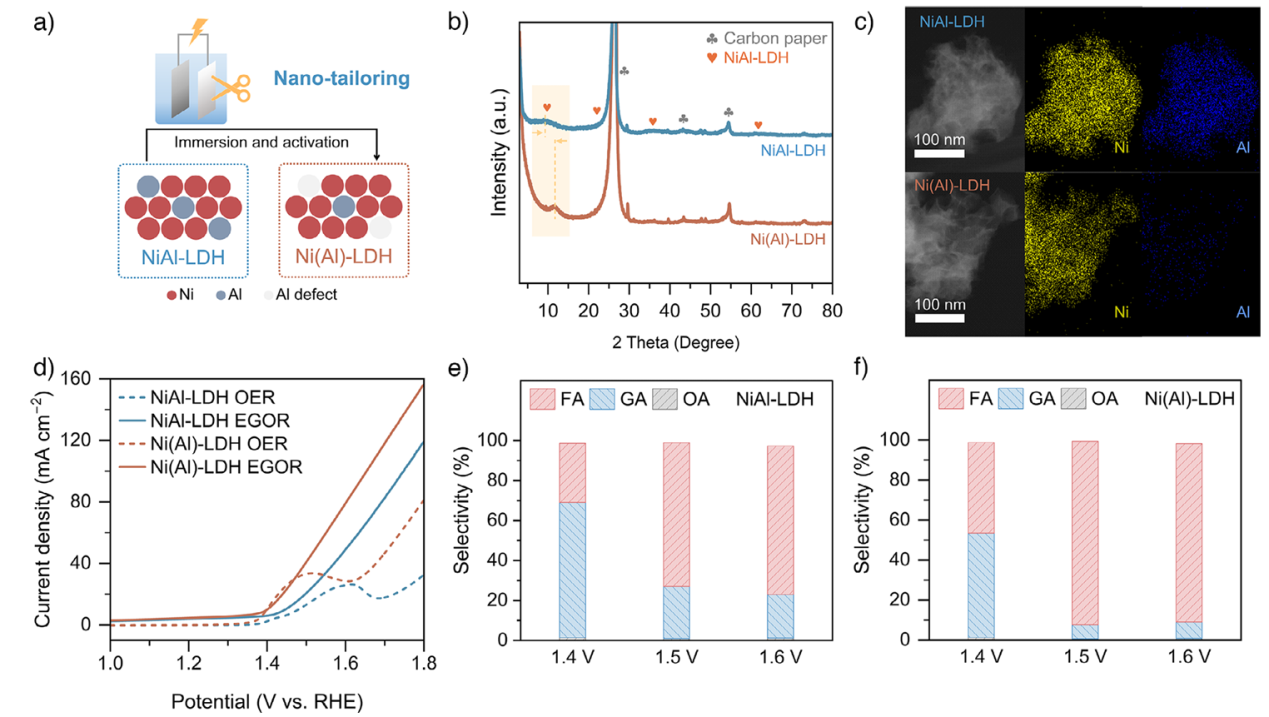
The figure shows the a) Schematic illustration of NiAl-LDH and Ni(Al)-LDH. The formation of defects can expose new active sites that help to enhance catalytic activity. b) XRD patterns and c) HRTEM-mappings of the NiAl-LDH and Ni(Al)-LDH. d) Anodic polarization curves of NiAl-LDH and Ni(Al)-LDH in the OER system (0.5 M KOH) and EGOR system (0.5 M KOH with 0.5 M EG). Selectivity of FA, GA and OA on e) NiAl-LDH and f) Ni(Al)-LDH at different potentials.
Electrocatalytic alcohol oxidation using tailored catalysts via selective cleavage of C(OH)–C(OH) bonds not only advances alcohol fuel cells and electrochemical hydrogen production, but also promotes green chemical synthesis. Reactive oxygen species such as OH* and lattice oxygen play a key role in this strategy. Unlike the commonly surface adsorbed OH, lattice oxygen exhibits unique activity and stability. Utilizing lattice oxygen to promote C(OH)–C(OH) bond cleavage improves the energy efficiency of alcohol oxidation and helps mitigate the risks of oxygen vacancy formation and catalyst instability in the conventional oxygen evolution reaction (OER). Previous studies have confirmed the existence of both reactive oxygen species. However, there is a lack of reports on the coexistence of parallel pathways within the same reaction system and on which reactive oxygen species (OH or lattice oxygen) plays the dominant role. Clarifying these issues is crucial for guiding the rational design of catalysts for highly selective C(OH)–C(OH) bond cleavage in alcohol electrooxidation.
In this work, this study prepared two model catalysts, NiAl LDH and Ni(Al) LDH, via an Al leaching method. Molecular probe experiments revealed that Ni(Al) LDH exposes additional lattice oxygen formation sites, and lattice oxygen contributes more than OH* to promoting C(OH)–C(OH) bond cleavage, thereby simultaneously enhancing the activity and product selectivity of alcohol electrooxidation. Critically, O isotope labeling, in situ Raman spectroscopy, mass spectrometry (MS), time of flight secondary ion mass spectrometry (TOF SIMS), and corresponding electrochemical measurements confirmed that EGOR follows the Mars–van Krevelen mechanism. Electrochemical kinetic experiments and density functional theory (DFT) calculations indicated that lattice oxygen subsequently mediates EGOR and C(OH)–C(OH) bond cleavage via an indirect oxidation pathway. Ni(Al) LDH increases the electron density on lattice oxygen, lowers its regeneration barrier, and weakens the metal–oxygen bond. Using EGOR as a model reaction, Ni(Al) LDH achieved approximately 90% selectivity for formate generation, significantly outperforming the pristine NiAl LDH which exhibited about 70% selectivity under the same conditions. Furthermore, substrate scope analysis revealed the unique activation ability of lattice oxygen toward C(OH)–C(OH) bonds. This study elucidates the mechanistic importance of lattice oxygen abundance in catalysts for achieving efficient C(OH)–C(OH) bond cleavage and ensuring high purity product formation during alcohol electrooxidation.
Article link: https://doi.org/10.1002/anie.202524156.