
The chemical upcycling of plastic waste into high-value-added products represents a highly promising pathway for achieving a circular economy and alleviating environmental issues. In recent years, the photothermal catalytic route reported has provided an environmentally friendly approach for plastic waste upcycling through the synergistic utilization of solar and thermal energy. However, the structural regulation mechanism of catalyst active sites under photothermal synergy remains unclear, which constrains the targeted design and performance optimization of catalysts. Therefore, the efficient upcycling of plastic waste into high-value-added products still poses a significant challenge.
Currently, Dou Yibo and his colleagues designed and constructed a layered double hydroxide (LDH) containing F–Zn active sites, which was applied to the efficient photothermal catalytic upcycling of waste poly(ethylene terephthalate) (PET) into bis(2-hydroxyethyl) terephthalate (BHET) (Scheme 1).
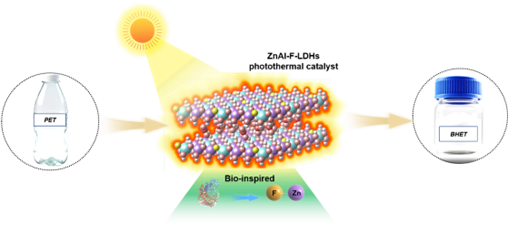
Scheme 1. Bio-inspired F-Zn dual active sites are designed in ZnAl-F-LDHs for the photothermal catalytic upcycling of PET waste into value-added BHET product.
Inspired by the catalytic mechanism of the active center of hydrolase enzymes, the researchers biomimetically constructed F–Zn dual active sites by substituting hydroxyl groups in the LDH layers with F atoms. Specifically, the introduced F atoms altered the coordination environment of Zn, generating unsaturated Zn²⁺ᵟ active sites. These unsaturated Zn²⁺ᵟ species serve as key active centers, enhancing the interaction with the carbonyl oxygen of PET ester bonds, increasing the electrophilicity of the carbonyl carbon, thereby facilitating its activation and promoting ester bond cleavage. Meanwhile, the highly electronegative F atoms form hydrogen bonds with nucleophilic reagents, rendering them electron-rich and thus enhancing their nucleophilic attacking capability. Combined with green photothermal catalysis, this biomimetic F–Zn structure achieved complete conversion of PET plastics at 160 °C, with a BHET yield as high as ~80%. This strategy provides new insights into the design of photothermal catalysts and holds significant application potential in the field of plastic waste valorization (Figure 1).
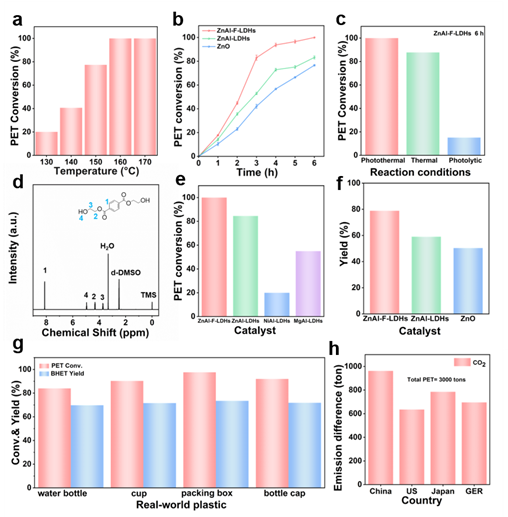
Figure 1.(a) PET conversion over ZnAl-F-LDHs at different reaction temperature. (b) PET conversion over ZnAl-F-LDHs, ZnAl-LDHs, and ZnO as the function of reaction time at 160 °C.(c) PET conversion under photothermal catalysis, thermal catalysis, and photocatalysis. (d) The1H-NMR result of BHET. (e) PET conversion for ZnAl-F-LDHs, ZnAl-LDHs, NiAl-LDHs and MgAl-LDHs. (f) The BHET yield of ZnAl-F-LDHs, ZnAl-LDHs and ZnO. (g) PET conversion and BHET yield converted from real-world plastic wastes over ZnAl-F-LDHs. (h) The impact of photothermal catalysis on reducing CO2 emission compared to thermal catalysis.
Original link: https://onlinelibrary.wiley.com/doi/10.1002/anie.8091533