
On April 22, 2026, Mingfei Shao's Group designed a novel photoelectrochemical (PEC) open-loop flow battery system toaddress the key challenges in chemicals (such as adipic acid) production andenergy utilization efficiency. This research results were published in “National Science Review” with titled “Photoelectrosynthesis of adipic acid coupled with energy storage in an open-loop flow battery”.
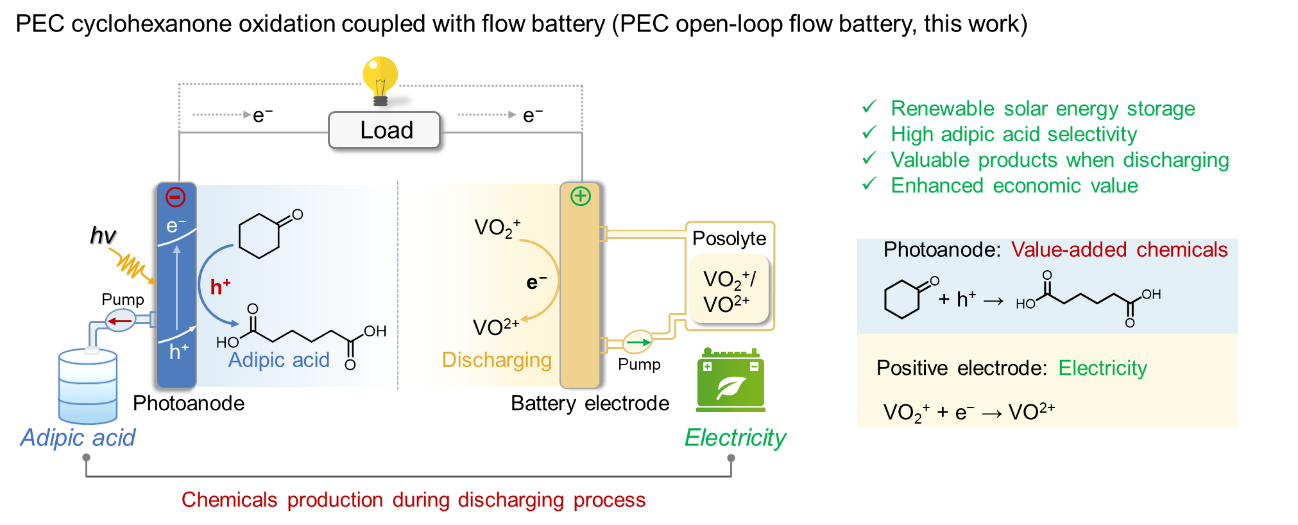
Fig. 1Schematic illustration of proposed PEC open-loop flow battery system for adipic acid production and electricity generation.
PEC oxidation of CYC to adipic acid offers a new sustainable synthesis approach, while efficient and selective transformation continues to pose a significant challenge. To address these challenges, Prof. Shao’s team designed aNiFeCu(OH)2/TiO2 as an efficientphotoanodefor CYC oxidation, achieving an adipic acid production rate of 5.6 μmol cm−2 h−1 with 95.3% selectivity at1.0 V vs. RHE in the H-type quartz cell. Experimental and theoretical evidence revealedthat Ni/Fe2+δ−OH* species serve as the actual reactivephase forCYC oxidation under illumination, which isin situ generatedfrom the oxidation of NiFe(OH)2 by thephotogenerated holes.
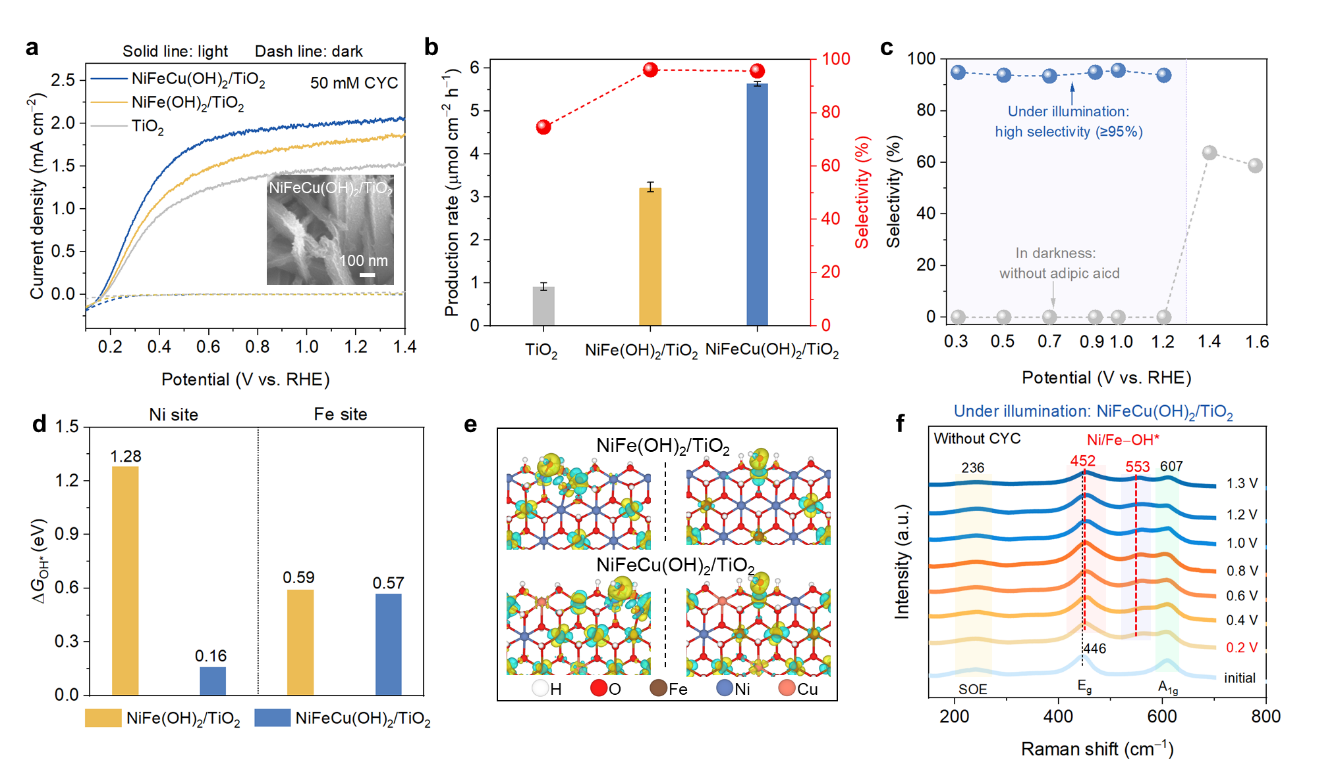
Fig. 2Photoelectrosynthesis of adipic acid and mechanism study. (a)LSVcurves of photoanodes in 0.5 M KOH with 50 mM CYC under AM 1.5G (100 mW cm−2) illumination and dark conditions.(b) Production rateand selectivity of adipic acid overphotoanodes. (c)Selectivity of adipic acid at different potentials overNiFeCu(OH)2/TiO2 photoanode under illumination or dark conditions. (d)Gibbs free energy of OH* formation overNiFe(OH)2/TiO2 and NiFeCu(OH)2/TiO2.(e)Charge density difference for OH* adsorption on Ni and Fe sitesforNiFe(OH)2/TiO2 andNiFeCu(OH)2/TiO2.(f)In-situ Raman spectra ofNiFeCu(OH)2/TiO2photoanode in 0.5 M KOH under illumination.
Moreover, traditional PEC systems typically require both sunlight and an external bias to ensure efficient and stable chemicals production, resulting in low energy utilization efficiency and onefold application scenarios.To improve the efficiency of solar energy storage and conversion, thePEC CYC oxidation was integrated with the reduction of vanadium pair (VO2⁺/VO2⁺) to construct a new PEC open-loop flow battery (OLFB) system. In this flow cell, the illumination area of NiFeCu(OH)2/TiO2photoanode is 9 cm2(a 3 cm × 3 cm flow cell), and a graphite felt was used as the negative electrode. As expected, the solar-driven OLFB discharged at ~1.3 V, delivering a capacity of 1.1 Ah L⁻1 and simultaneously producing adipic acid with a selectivity of ~94%.
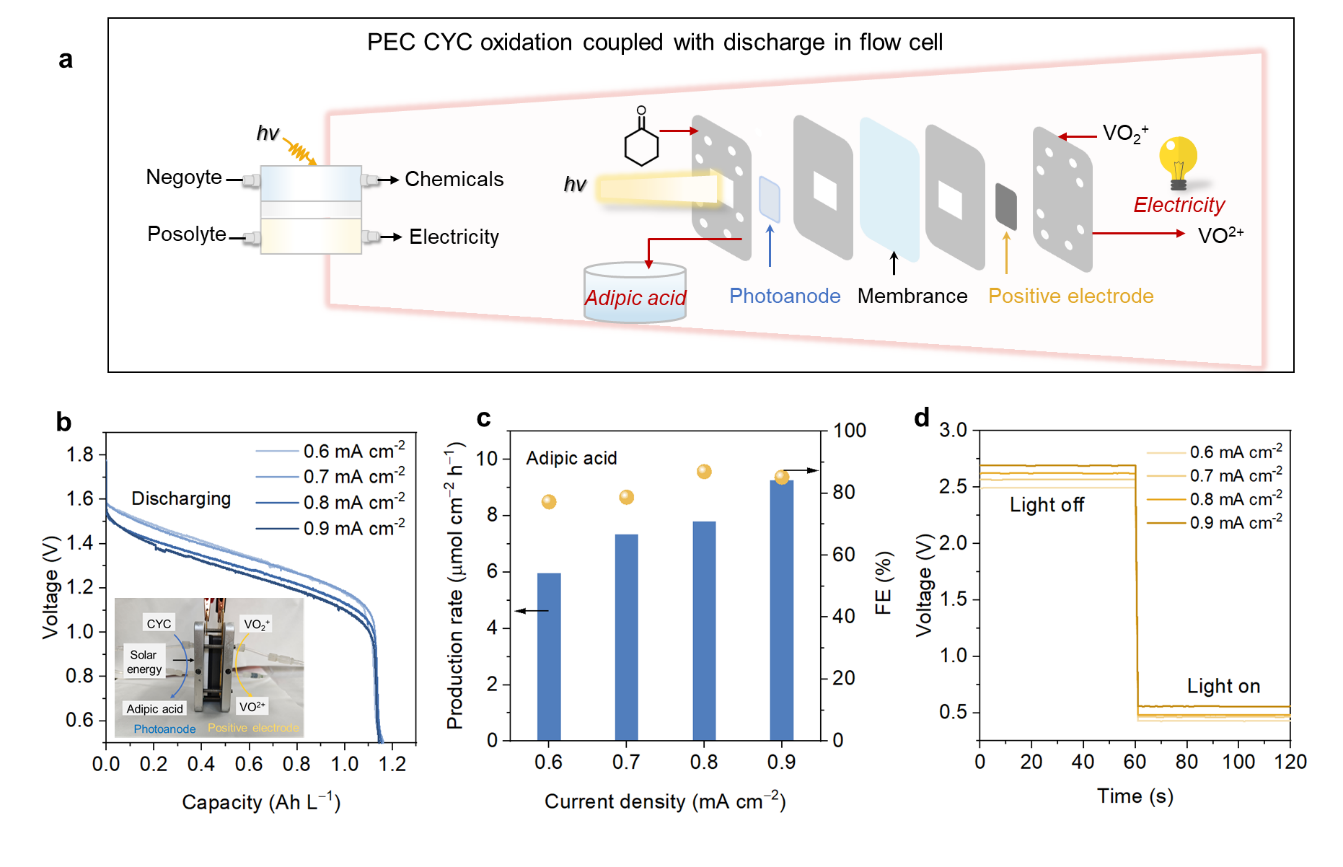
Fig. 3Performances ofPECOLFB inflow cell.(a) Schematic diagram ofPECOLFB system.(b) Discharge profiles performance of the PECOLFB at different current densities.(c) Production rate and FE of adipic acid after the battery discharge at different current densities. (d) Charging potential of PECOLFB under different current densities with/without illumination.
This studyprovides new insights into PEC adipic acid synthesis via solar-driven processes and shows great implication to advanced technology that couples energy storage with value-added chemicals synthesis.
Linkage:https://doi.org/10.1093/nsr/nwag236