
Recently, the research group led by Prof. Yufei Zhao from our institute, in collaboration with Zhejiang University, has made significant progress in the field of photothermal catalytic ammonia synthesis. Addressing key scientific challenges such as the low efficiency of magnetic metals for ammonia synthesis and the limited regulatory capability of promoter-mediated spin states, the team published their findings under the title "Solar-Driven Spin-State Optimization in Co-Based Catalysts for Enhanced Photothermal Ammonia Synthesis" in Advanced Materials. Jinhao Li from our institute is the first author, Prof. Yufei Zhao is the corresponding author, and our institute is the first affiliation.
The catalytic activity of magnetic transition metals is highly dependent on the spin-state configuration of their active sites. Previous studies have shown that introducing alkali/alkaline-earth metal promoters effectively reduces the local spin of magnetic metal surfaces to facilitate N2 dissociation. However, this static regulation strategy based on chemical modification is restricted by the intrinsic electronic structure of the catalyst; once the material is synthesized, its spin configuration is difficult to dynamically adjust during the reaction. To overcome this bottleneck, the research team proposed a novel photo-driven spin-state regulation strategy. By leveraging the localized surface plasmon resonance (LSPR) effect, the active sites are tuned from a high-spin to a low-spin state, resulting in a 3-fold increase in yield compared to thermal catalysis. Combined in situ characterizations and DFT calculations reveal the underlying mechanism, providing a new dynamic, reversible, and non-contact dimension for spin-state engineering.
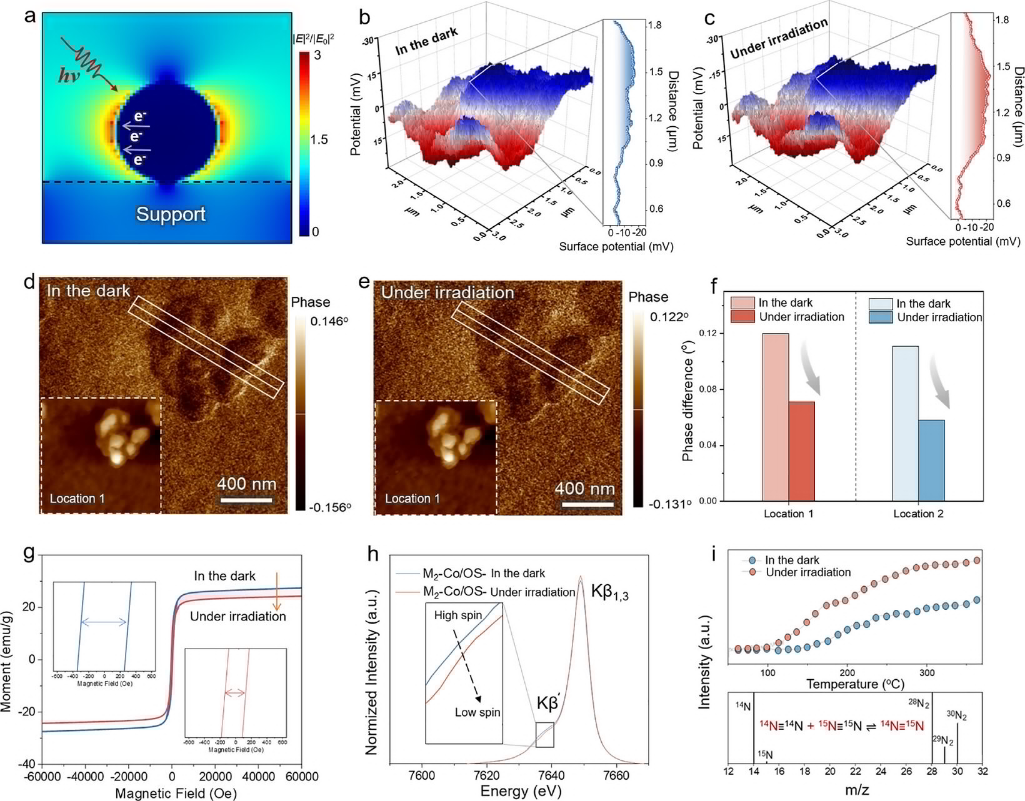
Figure 1. Light-induced enhancement of the local electric field and charge separation, along with the resulting changes in surface spin/magnetic properties.
FDTD simulations and in situ KPFM collectively confirm the strong LSPR effect and significant interfacial electron accumulation under light irradiation. In situ MFM reveals a pronounced decrease in the phase angle under illumination (indicating weakened local magnetic strength), while in situ VSM shows a significant, light-intensity-dependent monotonic decrease in saturation magnetization. Combined with in situ XES tracking the spin-state evolution of Co, the transition of surface Co to a low-spin state is established. Furthermore, isotope exchange experiments show a significantly accelerated exchange rate under light irradiation, directly confirming that the spin regulation mechanism effectively promotes N2 activation.
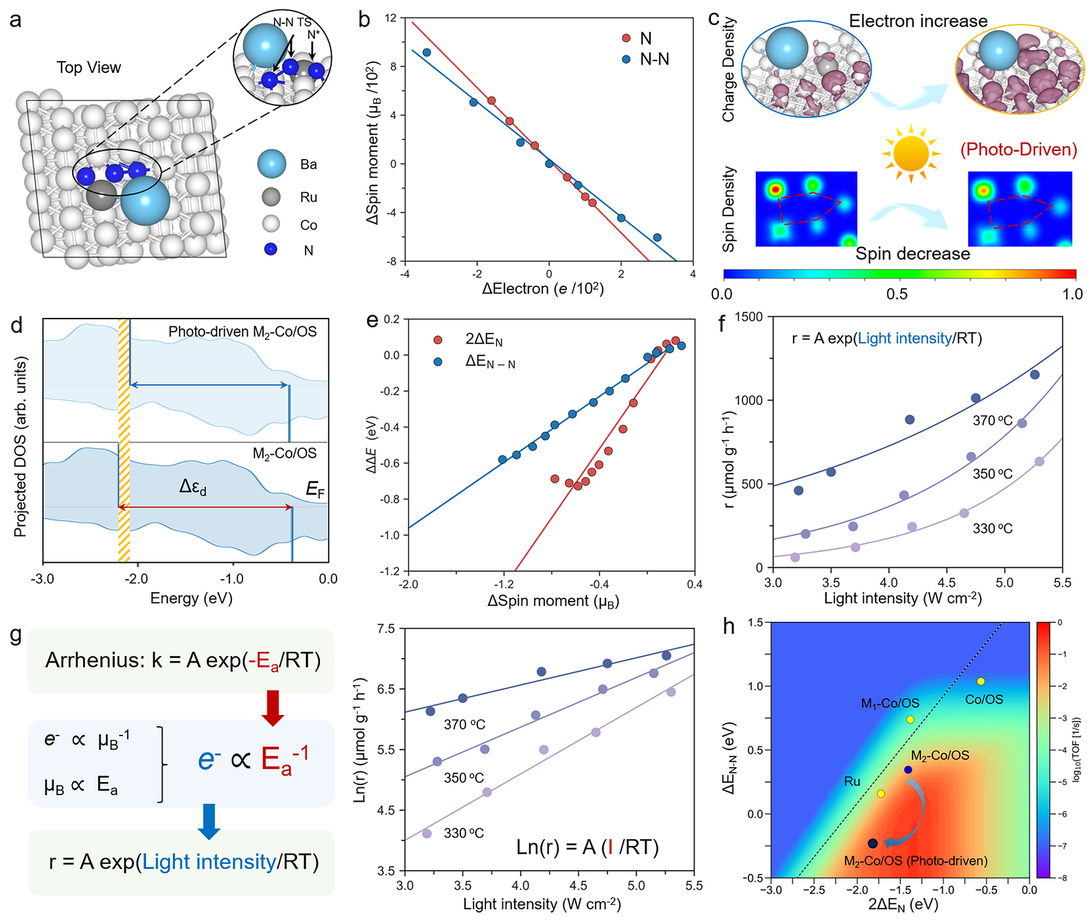
Figure 2. Theory-experiment combined analysis of light-driven spin changes, d-band center shifts, and reaction energy barrier variations.
Further combined DFT and experimental results demonstrate that the accumulation of photo-generated hot electrons reduces the spin magnetic moment of active Co sites, optimizing the interaction between Co d-orbitals and N₂ π* orbitals, weakening the N≡N bond, and lowering the N₂ dissociation barrier. The exponential correlation between light intensity and yield, along with the extended Arrhenius equation, further establishes the relationship between light intensity, spin state, and activation energy, revealing the microscopic mechanism of light-driven spin regulation. A two-dimensional activity volcano plot shows that the designed catalyst achieves ammonia synthesis performance near the volcano apex under illumination.
The core innovation of this strategy lies in transforming the spin state from a passive material property into a dynamic operational parameter that can be actively manipulated by light. Looking forward, this strategy can be extended to other photothermal reactions such as CO2 reduction and dry reforming of methane, as well as other spin-sensitive reactions. Furthermore, light-driven spin regulation can synergize with external fields such as magnetic and electric fields to explore new multi-field coupling spin regulation mechanisms, providing more possibilities for innovation in the field of green catalysis.