On September 28–29, 2026, the College of Chemistry successfully hosted the 6th “Frontiers in Interdisciplinary Chemistry Forum” (Cluster-Themed Forum) in the Academic Lecture Hall on the lower ground floor of the High-End, Precision, and Cutting-Edge Building at the Chaoyang Campus. The forum featured the following distinguished guests (listed in the order of their presentations): Professor Zhu Yan from Nanjing University; Professor Zhang Zhiming from Tianjin University of Technology; Professor Zheng Zhiping from Southern University of Science and Technology; Professor Chen Zhongning from Nanchang University; Professor Chen Ning from Soochow University; Professor Zhao Jijun from South China Normal University; Researcher Zhang Jian from the Fujian Institute of Research on the Structure of Matter, Chinese Academy of Sciences; Professor Zheng Yanzhen from Xi’an Jiaotong University; Professor Zhao Bin from Nankai University; Researcher Jiang Ling from the Dalian Institute of Chemical Physics, Chinese Academy of Sciences. Focusing on interdisciplinary frontiers in cluster science, these experts systematically presented the latest research findings on systems such as rare-earth clusters, metal fullerenes, superclusters, and boron clusters—covering areas including synthesis and preparation, structural analysis, excited-state regulation, photo/electrocatalysis, and optoelectronic devices—delivering a high-level academic program for faculty and students alike.
Dean Wei Min delivered an opening address on behalf of the College of Chemistry. She extended a warm welcome to the ten experts in attendance and expressed gratitude for their long-standing care and strong support for thecollege. In her remarks, Dean Wei provided an overview of the College of Chemistry’s achievements in talent development, discipline development, and scientific research. She noted that this forum serves as a platform for interdisciplinary exchange, helping to deepen academic communication, broaden the research horizons of faculty and students, spark innovative ideas, and further explore potential avenues for multi-party collaboration.
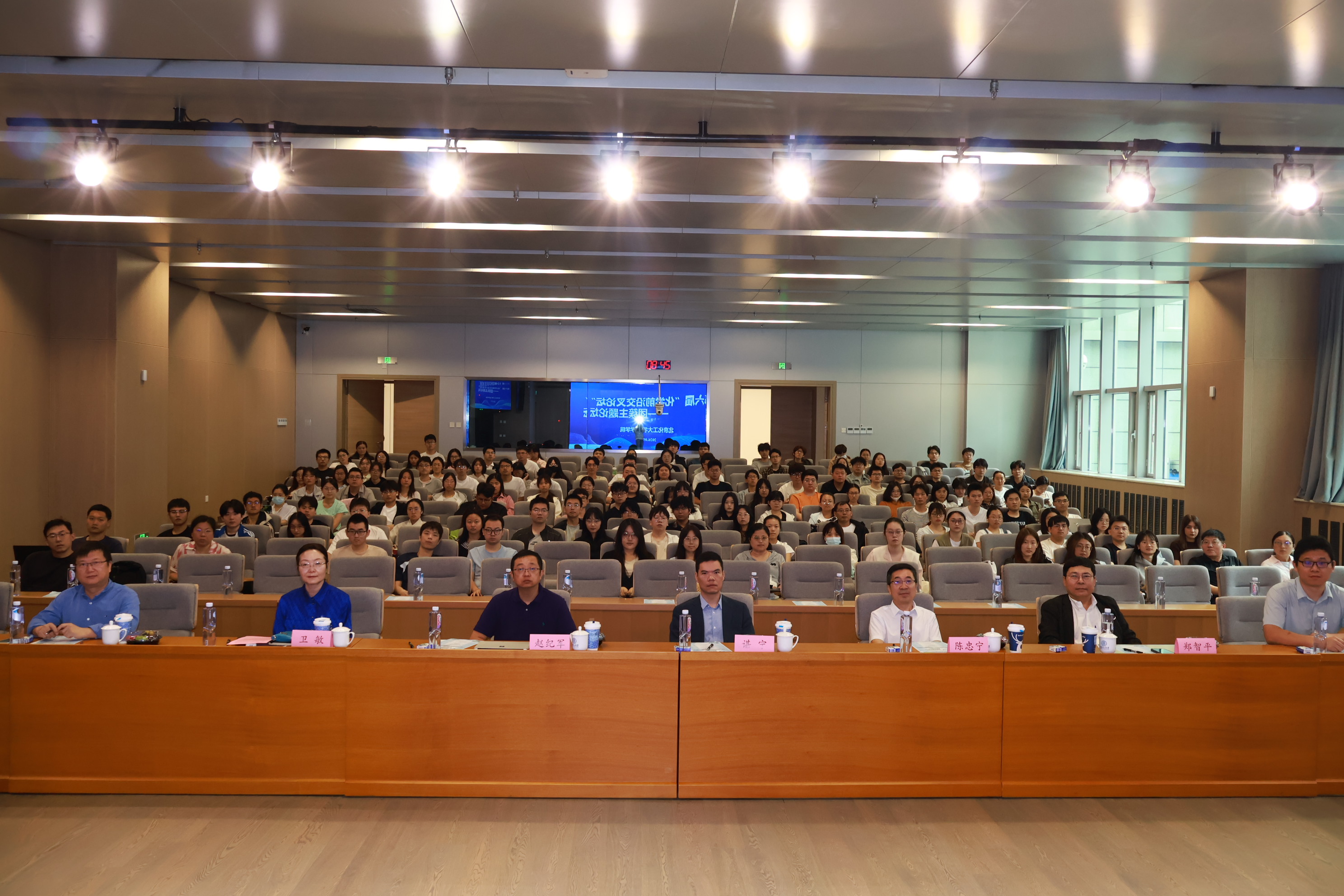
Group Photo
Professor Zhu Yan from Nanjing Universitydelivered a presentation titled “Atomically Precise Catalyst Design and Applications.” Focusing on atomically precise metal clusters and aiming to develop high-performance catalysts, she discussed the use of multidimensional assembly strategies to construct mesoscale multiphase catalytic materials, explore novel catalytic processes and reaction mechanisms, and advance the functional applications of atomic-level cluster catalytic materials. The presentation was rich in content and highly forward-looking, sparking lively discussions among the attending faculty and students.
Professor Zhang Zhiming from Tianjin University of Technologydelivered a presentation titled “Heterometallic Cluster Photocatalysts.” Addressing issues such as the encapsulation of active sites and weak visible light absorption in heterometallic cluster photocatalysts, he developed precise synthesis methods to construct materials with highly exposed active sites; he created a “heterometallic cluster@photosensitizer” system, elucidated the electron transfer mechanism, and achieved highly efficient photocatalytic hydrogen production and CO₂ reduction. The presentation was detailed and logically coherent, receiving an enthusiastic response from the faculty and students in attendance.
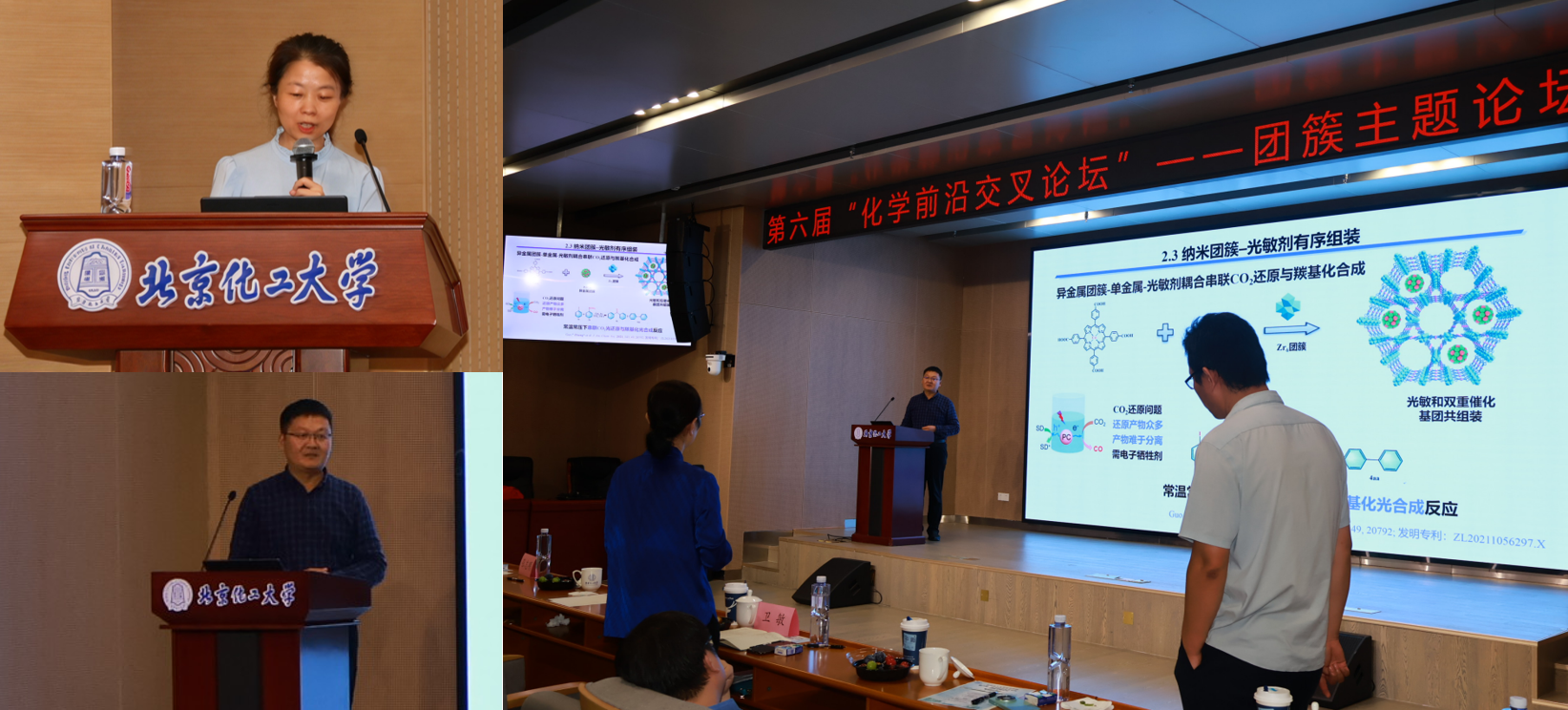
Scene from the Presentation
Professor Zheng Zhiping from Southern University of Science and Technologydelivered a presentation titled “From Serendipitous Discovery to Function-Oriented Development: The Evolution of Rare-Earth Clusters and the Exploration of Multifunctional Materials.” The presentation traced the developmental trajectory of rare-earth clusters from their serendipitous discovery to function-oriented research and development. It introduced original synthetic strategies such as “ligand-controlled hydrolysis” to construct a series of novel rare-earth oxoclusters and rare-earth organometallic clusters, showcasing the latest research findings on rare-earth clusters in the areas of controlled assembly and caged-cluster confined catalysis. Following the presentation, faculty and students in attendance engaged in an in-depth discussion with Professor Zheng on scientific issues such as synthetic control methods for rare-earth clusters, reaction mechanisms, and the optimization of catalytic performance.
Professor Chen Zhongning from Nanchang Universitydelivered a presentation titled “Exploration of Manganese Chelate Electrochromic Materials and Devices.” Addressing the challenge of achieving a colorless state in high-performance electrochromic materials, he designed and synthesized manganese-based chelates and transparent metal polymer films, enabling reversible switching between colorless, brownish-yellow, and blue states. The device demonstrated excellent cycling stability, and the team successfully fabricated a large-area, flexible device measuring 400 cm², validating its potential for practical applications. The presentation focused closely on the structure-property relationships of molecular electrochromic materials and key technologies for device engineering, highlighting the translation of basic research into practical applications.
Professor Chen Ning from Soochow Universitydelivered a keynote presentation titled “Structural Chemistry of Metal-Embedded Fullerenes.” Focusing on lanthanide and actinide embedded metal fullerenes, he achieved the construction and characterization of multiple bonds involving various f-block metals and single-electron metal-metal bonds within carbon cages, and discovered molecular qubit properties. By utilizing the confined environment of fullerenes, he obtained special chemical bonds and clusters that are difficult to prepare through conventional chemistry, revealing unique molecular magnetic properties. Following the presentation, Professor Chen engaged in an in-depth discussion with faculty and students in attendance on topics including synthesis and separation methods for embedded-metal fullerenes, bonding mechanisms of f-block elements, and practical development prospects.
Professor Zhao Jijun from South China Normal University delivered a presentation titled “Excited-State Engineering of Molecules and Clusters: Exciton Control and Singlet Splitting Screening.” He explored the laws governing exciton regulation in molecules and clusters from a theoretical perspective, achieving luminescence modulation in clusters and the construction of low-voltage photoelectronic switches; he also investigated the exciton evolution behavior in fullerene composite systems. By establishing an AI-based high-throughput screening framework, he rapidly identified functional molecules with singlet-state splitting, providing new insights for the design of excited-state functional materials. Following the presentation, Professor Zhao engaged in in-depth discussions with faculty and students in attendance.
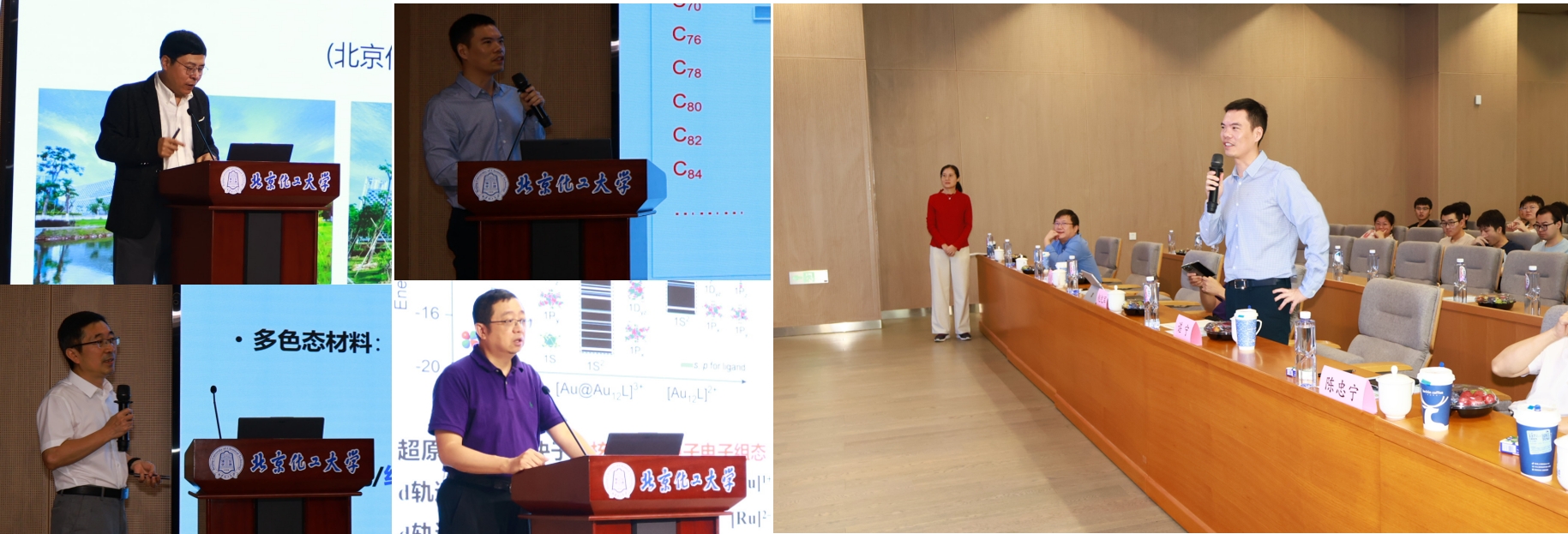
Scene from the Presentation
Researcher Zhang Jian from the Fujian Institute of Research on the Structure of Matter, Chinese Academy of Sciences, delivered a presentation titled “Supercluster Chemistry.” He introduced supercluster systems such as titanium/aluminum/tin-oxo clusters, proposed new synthetic methods such as “metal ion coordination delay,” and developed highly active cluster catalytic systems; at the same time, he developed cluster-based chiral luminescent materials and new photoresist materials, expanding the applications of superclusters in the fields of catalysis, optoelectronics, and microelectronics. Following the presentation, Researcher Zhang Jian engaged in an in-depth exchange with faculty and students regarding controllable synthetic strategies and functional modification pathways for superclusters.
Professor Zheng Yanzhen from Xi’an Jiaotong University delivered a presentation titled “Synthesis and Properties of Fluorine-Bridged Rare-Earth Clusters.” Addressing the challenges in synthesizing fluorine-bridged rare-earth clusters, he employed a mixed-ligand solvothermal method to prepare a series ofhigh-nuclear, stable fluorine-bridged rare-earth clusters. The use of fluoride ions as bridging groups effectively suppressed non-radiative transitions and enhanced luminescence efficiency, demonstrating the application potential of these clusters in magnetism, luminescence, and LED devices. After the presentation, faculty and students in the audience asked questions regarding the controlled synthesis of high-nuclear fluoride-bridged rare-earth clusters and structure-property relationships. Drawing on his many years of research practice and accumulated experience, Professor Zheng provided patient and detailed answers.
Professor Zhao Bin from Nankai University delivered a presentation titled “Assembly of Stable Clusters and Their Catalytic Conversion of CO₂,” in which he introduced the synthesized multicenter metal-bonded clusters and revealed the intrinsic relationship between cubic aromaticity and cluster stability. By assembling stable clusters into porous materials, he investigated the synergistic mechanism of active centers in the catalytic conversion of CO₂, providing both experimental and theoretical support for the development of catalysts for high-value CO₂ utilization. Faculty and students in attendance actively asked questions regarding cluster assembly strategies, cubic aromaticity, and the regulation of selectivity in the catalytic conversion of CO₂, among other topics. Professor Zhao provided detailed answers to each question based on his own research findings, fostering a vibrant atmosphere of discussion.
Researcher Jiang Ling from the Dalian Institute of Chemical Physics, Chinese Academy of Sciences, delivered a presentation titled “Study on the Structural Evolution Mechanism of Neutral Boron Clusters,” exploring changes in the geometric configurations of neutral boron clusters with different numbers of atoms, revealing the intrinsic mechanisms underlying boron cluster skeleton growth and structural evolution, enriching the fundamental scientific understanding of boron clusters, and providing a theoretical basis for the research and development of boron-based functional materials. Following the presentation, faculty and students in attendance actively posed questions regarding theoretical prediction methods for cluster geometries and approaches to functionalizing boron clusters. Dr. Jiang addressed each question in turn, drawing on both experimental and theoretical research findings, and engaged in thorough academic discussion.
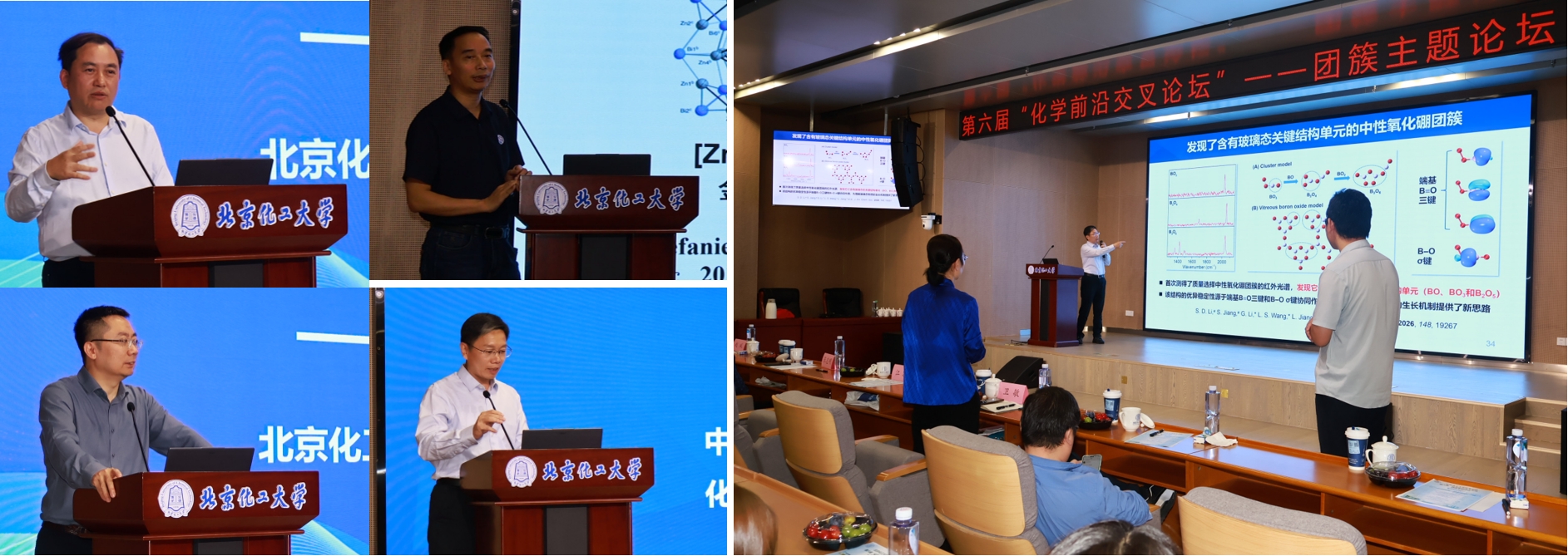
Scene from the Presentation
The entire forum featured cutting-edge content that not only focused on key issues in basic science but also explored practical functional applications; it provided a systematic overview of the discipline’s development while presenting the latest research findings in the field of clusters, thereby broadening the academic horizons of participating faculty and students in cluster science. The forum established a high-level platform for academic exchange in cluster science, widening the research perspectives of faculty and students, inspiring innovative research ideas, and promoting academic exchange and collaboration among research teams both within and outside the university. It laid a solid foundation for advancing interdisciplinary and cross-institutional collaborative research in the future.