
Recently, Professor Li Feng’s team atthe College of Chemistry, in collaboration with the National Engineering Center for New Vaccine Research, has made significant progress in the fields of novel nanovaccine technology and immunomodulatory materials. Addressing key scientific challenges—such as enhancing the immunogenicity of subunit vaccines and overcoming the insufficient activation of cellular immunity by traditional adjuvants—the team has published two research papers consecutively in the Journal of the American Chemical Society (JACS) andAngewandte Chemie International Edition.
As a crucial technological tool for the prevention and control of infectious diseases, vaccines are evolving from traditional formulations toward a new generation of precision-engineered and intelligent vaccine systems. However, while subunit vaccines—which are currently widely used—offer advantages such as high safety and well-defined composition, they often face bottlenecks such as insufficient cellular immune activation and limited duration of immune memory due to a lack of effective innate immune stimulation signals. These challenges remain particularly significant when addressing respiratory viral infections, complex viruses, and diseases requiring potent T-cell immune protection. To address these issues, the research team focused on the research theme of “Precise Design of Nanomaterials to Drive Efficient Regulation of Immune Signals and Long-Lasting Protection” and developed a series of novel nanoadjuvants and nanovaccine platforms capable of synergistic immune activation through multiple pathways.
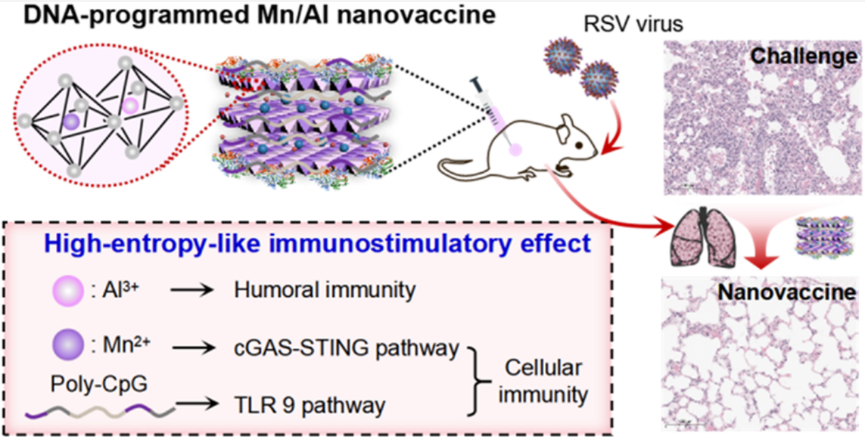
In a study published in the Journal of the American Chemical Society, the team proposed a novel RSV subunit vaccine platform based on the orthogonal nanoadjuvant design concept. This system utilizes Mn/Al Layered Double Hydroxide (Mn/Al-LDH) nanomaterials as immune-regulatory carriers and combines them with DNA structures containing CpG sequences to achieve synergistic activation of different immune pathways. Specifically, the aluminum component primarily promotes antibody-mediated humoral immunity, while manganese ions and CpG respectively activate the cGAS-STING and Toll-like receptor (TLR)-related pathways, thereby forming a multidimensional immune activation pattern resembling a “high-entropy immune stimulation effect.” The study found that this nanovaccine significantly promotes the activation of antigen-presenting cells, enhances CD4⁺ and CD8⁺ T-cell responses, and establishes long-term immune memory. In an animal model of RSV infection, this strategy demonstrated stronger viral clearance and lung tissue protection compared to traditional aluminum-adjuvanted vaccines, providing a new technical pathway for the development of next-generation RSV vaccines and other viral vaccines.
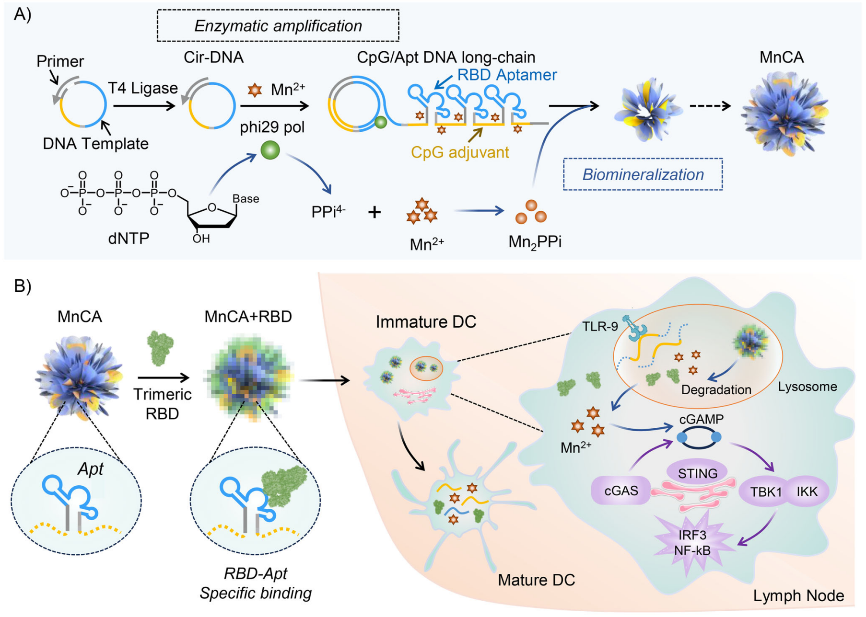
Meanwhile, in another study published in Angewandte Chemie International Edition, the team further developed a nanovaccine platform based on manganese pyrophosphate-mineralized DNA. This system constructs functionalized long DNA chains via rolling circle amplification and utilizes a manganese ion-mediated biomineralization process to form manganese pyrophosphate (Mn₂PPi)-mineralized DNA nanoadjuvants in a single step under ambient temperature, atmospheric pressure, and physiological pH conditions, thereby enabling the precise integration of immunostimulatory molecules.
The study revealed that Mn²⁺ and CpG DNA exert synergistic immunomodulatory effects by simultaneously activating the TLR9 and cGAS-STING signaling pathways, effectively enhancing Th1-type cellular immune responses and addressing the shortcomings of traditional aluminum salt adjuvants in inducing cellular immunity. Animal experiments further demonstrated that this DNA nanoadjuvant system significantly enhances antigen-specific cellular immunity and promotes more balanced and long-lasting immune protection.
The two studies mentioned above demonstrate the research team’s ongoing capacity for innovation in the fields of nanomaterial design, immune adjuvant development, and vaccine delivery technology. By establishing a systematic research framework encompassing “material structure design—immune signal regulation—vaccine efficacy evaluation,” the team has transcended the traditional single-adjuvant model of immune activation and proposed a new strategy of multi-pathway synergistic regulation, providing a crucial theoretical foundation and technological resources for the development of next-generation vaccine technology.
In the future, the team will continue to address the needs of major infectious disease prevention and control by focusing on novel nanodelivery systems, composite immunological adjuvants, and precision vaccine design. They will accelerate the translation of basic research findings into innovative vaccine products and practical applications, thereby contributing to independent innovation and the advancement of vaccine technology in China’s biopharmaceutical sector.